Materials, Earthmoving, and Roads
Rock: bulk density 2700 kg/m3, repose 89 deg.
Earthmoving Machinery Specifications
The 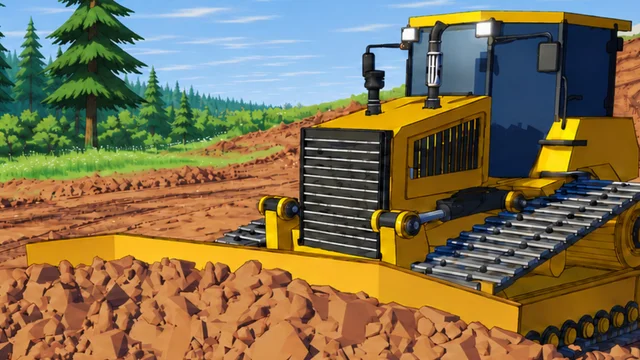 Crawler dozer operates with a vehicle mass of 16.7 tonnes and an engine power rating of 150 kW.
Leasing the crawler dozer costs 160 per hour, while purchasing it outright costs 135,000.
The front dozer blade measures 4.08 m in width by 1.263 m in height.
The 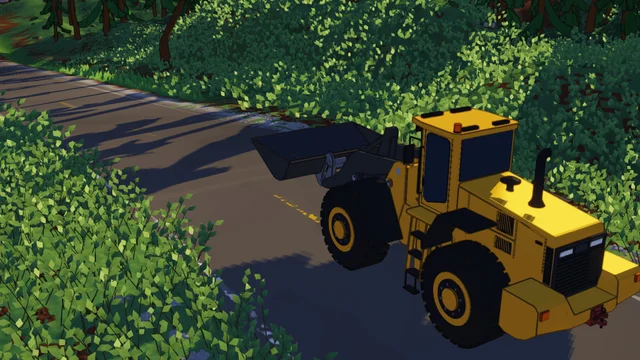 Wheel loader operates with an operating mass of 10.0 tonnes and an engine rating of 110 kW.
Leasing the wheel loader costs 85 per hour, while buying the machine costs 64,000.
Standard equipment on the wheel loader features a 1.8 m3 bucket with a width of 2.34 meters.
Material Physical Properties and Slope Mechanics
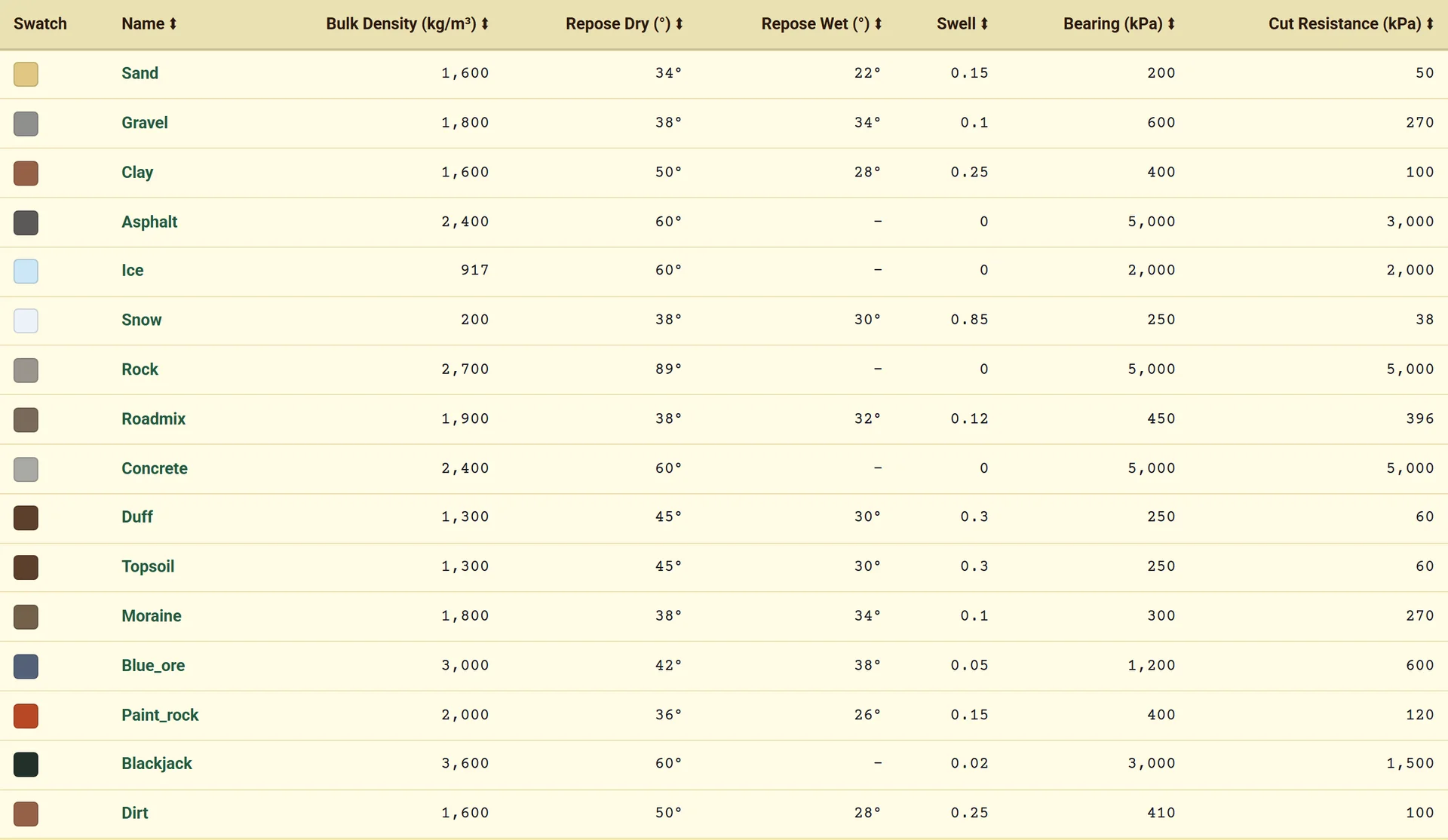
Sand has a bulk density of 1600 kg/m3, a dry repose angle of 34.0 deg, and a wet repose angle of 22.0 deg.
 Gravel has a bulk density of 1800 kg/m3, a dry repose angle of 38.0 deg, and a wet repose angle of 34.0 deg.
Clay has a bulk density of 1600 kg/m3, a dry repose angle of 50.0 deg, and a wet repose angle of 28.0 deg.
Asphalt has a bulk density of 2400 kg/m3, a repose angle of 60.0 deg, and a swell factor of 0%.
Rock has a bulk density of 2700 kg/m3, a repose angle of 89.0 deg, and a swell factor of 0%.
Roadmix has a bulk density of 1900 kg/m3, a dry repose angle of 38.0 deg, and a wet repose angle of 32.0 deg.
Concrete has a bulk density of 2400 kg/m3, a repose angle of 60.0 deg, and a swell factor of 0%.
Topsoil has a bulk density of 1300 kg/m3, a dry repose angle of 45.0 deg, and a wet repose angle of 30.0 deg.
Dirt has a bulk density of 1600 kg/m3, a dry repose angle of 50.0 deg, and a wet repose angle of 28.0 deg.
Duff has a bulk density of 1300 kg/m3, a dry repose angle of 45.0 deg, and a swell factor of 30%.
Moraine has a bulk density of 1800 kg/m3, a dry repose angle of 38.0 deg, and a wet repose angle of 34.0 deg.
Ice has a bulk density of 917 kg/m3, a repose angle of 60.0 deg, and a swell factor of 0%.
Snow has a bulk density of 200 kg/m3, a dry repose angle of 38.0 deg, and a swell factor of 85%.
Blue-ore has a bulk density of 3000 kg/m3, a dry repose angle of 42.0 deg, and a wet repose angle of 38.0 deg.
Paint-rock has a bulk density of 2000 kg/m3, a dry repose angle of 36.0 deg, and a wet repose angle of 26.0 deg.
Blackjack has a bulk density of 3600 kg/m3, a repose angle of 60.0 deg, and a swell factor of 2%.
Bearing Capacity, Cut Resistance and Compaction
Sand maintains a bearing capacity of 200000, a cut resistance of 50000, and a compact pressure of 55000.
Gravel maintains a bearing capacity of 600000, a cut resistance of 270000, and a compact pressure of 55000.
Clay maintains a bearing capacity of 400000, a cut resistance of 100000, and a compact pressure of 55000.
Asphalt maintains a bearing capacity of 5000000 and a cut resistance of 3000000.
Rock maintains a bearing capacity of 5000000 and a cut resistance of 5000000.
Roadmix maintains a bearing capacity of 450000, a cut resistance of 396000, and a compact pressure of 55000.
Concrete maintains a bearing capacity of 5000000 and a cut resistance of 5000000.
Topsoil maintains a bearing capacity of 250000, a cut resistance of 60000, and a compact pressure of 40000.
Dirt maintains a bearing capacity of 410000, a cut resistance of 100000, and a compact pressure of 55000.
Duff maintains a bearing capacity of 250000, a cut resistance of 60000, and a compact pressure of 40000.
Moraine maintains a bearing capacity of 300000, a cut resistance of 270000, and a compact pressure of 55000.
Ice maintains a bearing capacity of 2000000 and a cut resistance of 2000000.
Snow maintains a bearing capacity of 250000, a cut resistance of 37500, and a compact pressure of 18000.
Blue-ore maintains a bearing capacity of 1200000, a cut resistance of 600000, and a compact pressure of 55000.
Paint-rock maintains a bearing capacity of 400000, a cut resistance of 120000, and a compact pressure of 55000.
Blackjack maintains a bearing capacity of 3000000, a cut resistance of 1500000, and a compact pressure of 80000.
Complete Material Specifications Table
| Material | Bulk density | Swell factor | Dry repose | Wet repose | Bearing capacity | Cut resistance |
|---|---|---|---|---|---|---|
| sand | 1600 kg/m3 | 15% | 34.0 deg | 22.0 deg | 200000 | 50000 |
| gravel |
1800 kg/m3 | 10% | 38.0 deg | 34.0 deg | 600000 | 270000 |
| clay | 1600 kg/m3 | 25% | 50.0 deg | 28.0 deg | 400000 | 100000 |
| asphalt |
2400 kg/m3 | 0% | 60.0 deg | - | 5000000 | 3000000 |
| ice | 917 kg/m3 | 0% | 60.0 deg | - | 2000000 | 2000000 |
| snow | 200 kg/m3 | 85% | 38.0 deg | 30.0 deg | 250000 | 37500 |
| rock | 2700 kg/m3 | 0% | 89.0 deg | - | 5000000 | 5000000 |
| roadmix |
1900 kg/m3 | 12% | 38.0 deg | 32.0 deg | 450000 | 396000 |
| concrete |
2400 kg/m3 | 0% | 60.0 deg | - | 5000000 | 5000000 |
| duff |
1300 kg/m3 | 30% | 45.0 deg | 30.0 deg | 250000 | 60000 |
| topsoil |
1300 kg/m3 | 30% | 45.0 deg | 30.0 deg | 250000 | 60000 |
| moraine |
1800 kg/m3 | 10% | 38.0 deg | 34.0 deg | 300000 | 270000 |
| blue-ore | 3000 kg/m3 | 5% | 42.0 deg | 38.0 deg | 1200000 | 600000 |
| paint-rock | 2000 kg/m3 | 15% | 36.0 deg | 26.0 deg | 400000 | 120000 |
| blackjack |
3600 kg/m3 | 2% | 60.0 deg | - | 3000000 | 1500000 |
| dirt | 1600 kg/m3 | 25% | 50.0 deg | 28.0 deg | 410000 | 100000 |
Road Types and Layer Specifications
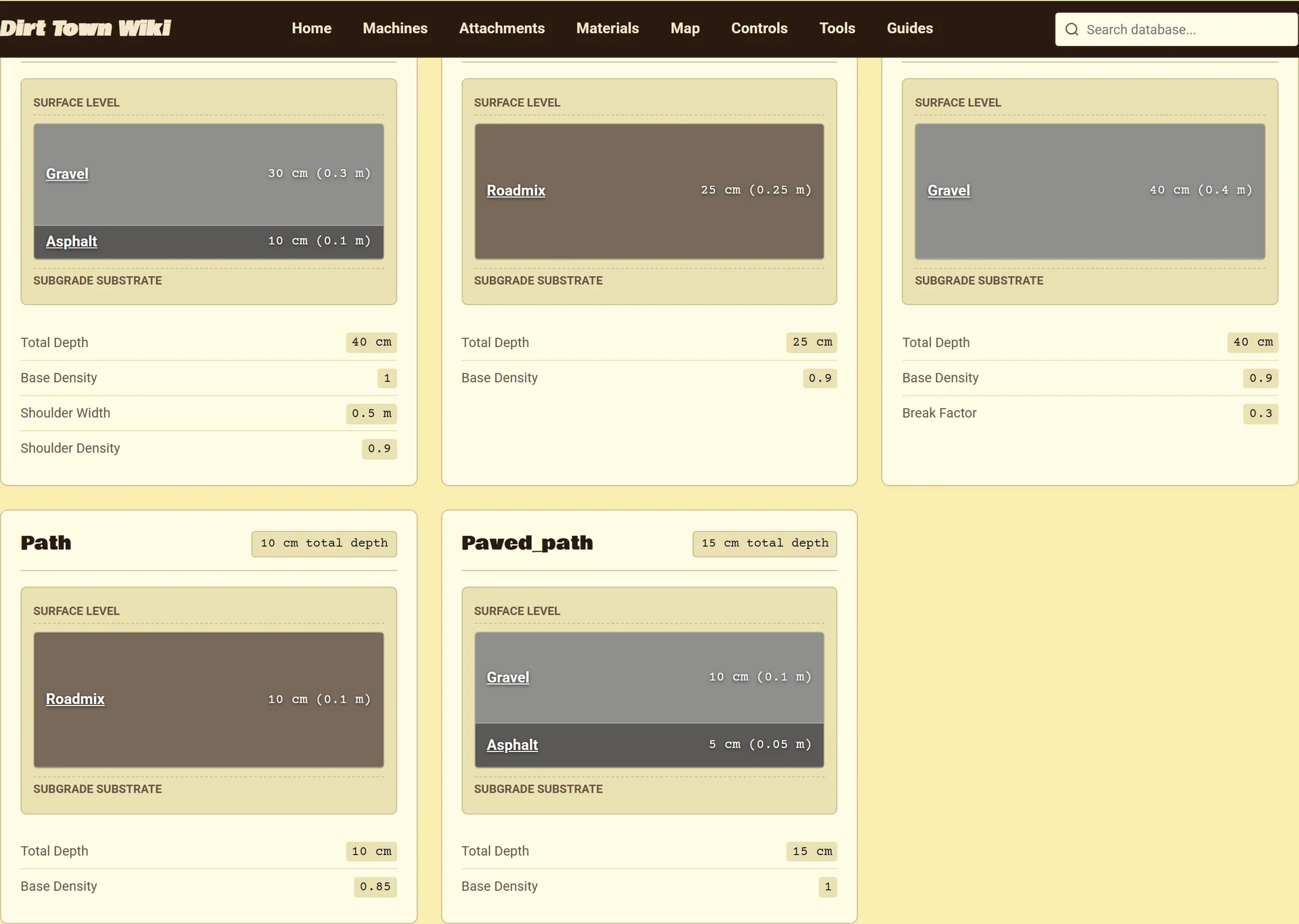
- Paved road construction calls for a total thickness of 0.4 m with a surface density of 1.0.
- The paved structure incorporates a 0.3 m gravel base beneath a 0.1 m asphalt layer.
- Paved roadways include an unpaved shoulder of 0.5 m with a shoulder density of 0.9.
- Dirt road segments use a single 0.25 m layer of roadmix compacted to 0.9 density.
- The shoulder width for dirt roads is 0.0 m.
- Railway beds require a 0.4 m ballast layer of gravel at a density of 0.9.
- Rail ballast shoulders measure 0.0 m in width.
- Standard paths use a 0.1 m layer of roadmix with a target density of 0.85.
- Paved paths combine a 0.1 m gravel base with a 0.05 m asphalt surface.
- The combined paved path reaches 0.15 m total thickness at a density of 1.0.
Grade Limits and Bridge Design Rules
- The maximum permissible slope grade across road networks is 8 percent.
- Nominal mainline grade across standard road profiles is set at 6 percent.
- Roadside drainage ditches have a width of 4.8 m and a baseline depth of 0.6 m.
- Ditch depth can extend up to a maximum depth of 1.2 m.
- Roadside verges feature a 0.3 m topsoil layer placed at 0.6 density.
- Concrete bridge decks are designed with a thickness of 0.6 m.
- Bridges carry a grade specification of 4 percent.
- Bridge safety barriers measure 0.5 m wide and 0.8 m high.
- Vertical clearance underneath the bridge deck provides 4.5 m of headroom.
- Structural bridge support piers are 1.0 m thick and spaced at intervals of 12.0 m.